Melbourne, Australia
Read · Test · Keep
I got the ad right before I made the workflow reusable
How I worked from poor AI Meta ads to static and video creative I was happy with, then built a reusable workflow from the successful sessions.
When the ads looked bad
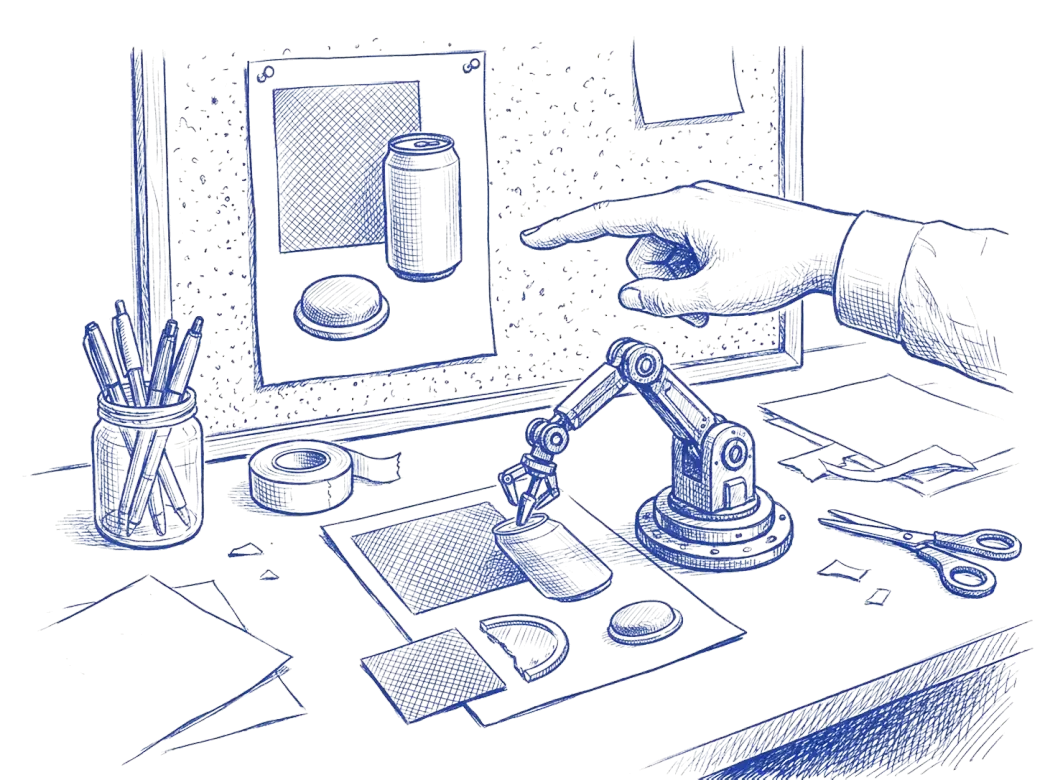
My earlier AI-generated Meta ads had bad visuals and a bad layout. The copy was poor. The biggest issue was that they looked bad and didn't make sense.
It was hit and miss, with more misses than hits. There wasn't much value in making that process repeatable while I was still rejecting what it produced.
The improvement I want to describe here is creative quality. I reached a point where I was happy with the static ads, then used the same approach to make video ads. I watched the videos myself. Some variations still went wrong, and I had to correct them.
I haven't supplied campaign results for this account. What changed was the work I was prepared to use.
I wasn't the only one staring at bad output. The YouTube Ads team has described the assets they were dealing with as messy ad creatives, with low-quality images, cluttered visuals and heavy text overlays. They built an agent that cleaned those up, and the lesson they drew from it wasn't that the model needed better instructions. In a talk they gave about evals and prompts, prompting alone never produced stable behaviour for them, so they built a loop instead, where the checks fed back into the next attempt rather than just scoring the result.
They were up against the same problem at a scale I didn't have, and reached much the same conclusion about prompts.
What I was comparing them with
I had existing static Meta ads that a professional had made. Those were the reference. I compared the new outputs with that work and with my older AI attempts.
The newer static ads looked so close to the professional originals that I struggled to tell the difference. That's my assessment of the creative, rather than a claim that an independent reviewer couldn't distinguish them.
The reference material was the professionally made static ads themselves. I hadn't supplied a separate brand guide for this work. When I asked the workflow to stay on brand, those ads were what it had to work from.
That comparison gave my account a specific limit. I was judging the new work against creative made for the provider, rather than deciding in isolation that something looked impressive. My earlier AI attempts were the other comparison, and those had given me plenty of work I didn't want to use.
Pointing the work at a human-made reference is a move other people make too. The trade coverage of Google's new Asset Studio workflow describes a brand step that comes first, where you import your brand guidelines and a URL before it generates anything. What you hand it is what it reasons over, and advertisers still have to check whether the result genuinely holds the brand.
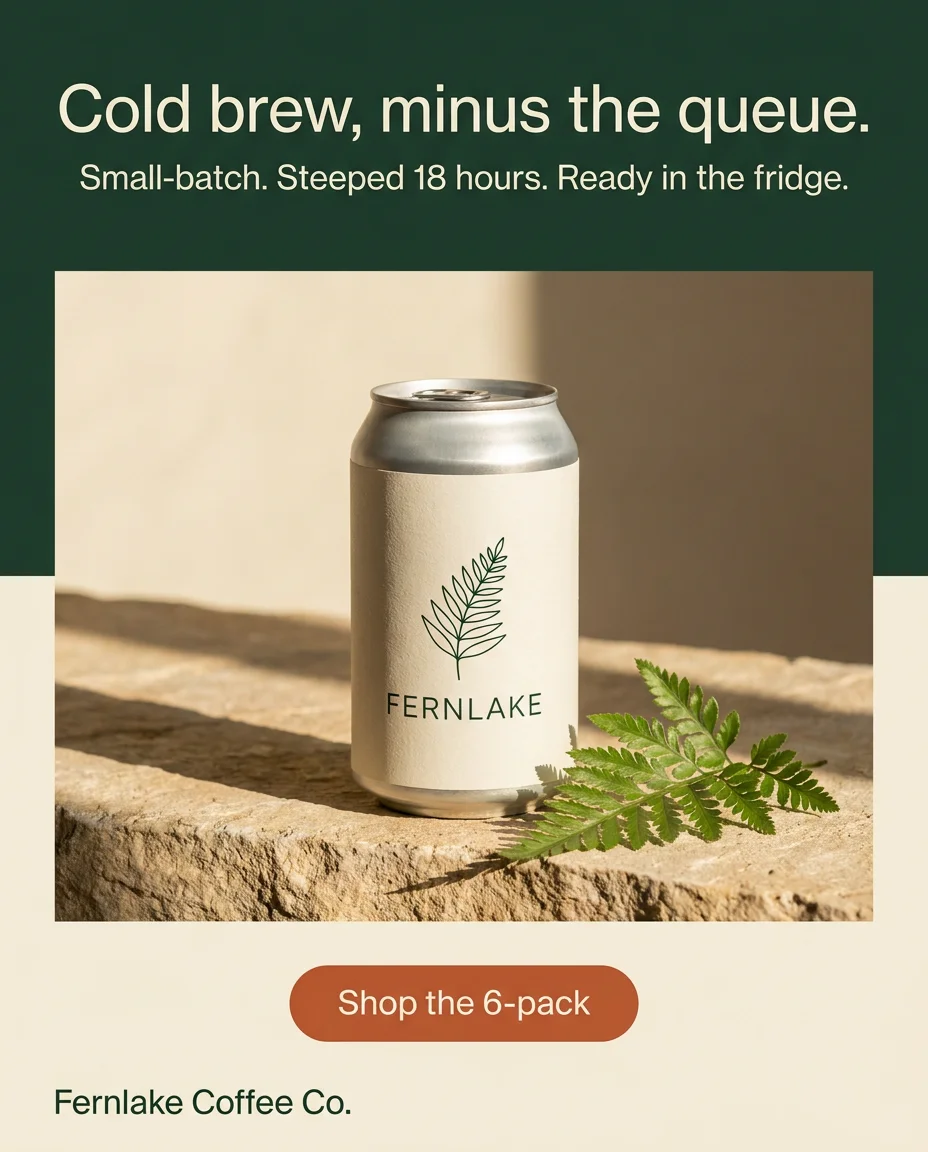
I can't show the branded work in this article. The examples below are separate from the private work behind this account.
Getting one working session right
The useful preparation happened before the short request that produced the variations.
I gave the AI access to tools that could build the assets, along with a skill for using them, which is the written instructions the AI followed when it used those tools. In this case those tools could create JavaScript, HTML and CSS-style animations. I talked through the process of coming up with the creative, then worked on the result in the session.
That meant feedback and adjustments while I was still trying to get a complete ad right. I wasn't beginning with a finished set of reusable instructions and assuming the creative would follow.
I described the order like this:
Don't worry about making it repeatable just now. Just focus on getting it right.
Once I had a working session producing good results, I used that successful work as the example for building the reusable workflow. The workflow came from something I had already worked through and tweaked.
The Work2Skill paper builds an agent's skills out of what a person does on a screen. It records human demonstrations of a graphical interface and turns them into reusable skills an agent can follow. A demonstration is the input, and the skill it produces comes after rather than before.
The tools and the skill were in the work too. The reference ads were what the AI could reach, the tools were what it could do, and the instruction to keep it close to the original brand was what it paid attention to. A piece in the MIT Sloan Management Review, Stop Prompting AI. Start Directing It, argues for configuring what an agent can reach, what it can do and what it pays attention to, rather than trying to get the right answer out of a prompt.
This distinction matters when I describe the short request I used later. By then the tools and the skill were already behind it, as was the work of developing the process. Quoting only the final request would leave that preparation out of the story.
I was working towards an ad I considered usable, then building from the session that got me there. That successful work gave me a specific example for the reusable workflow, rather than only instructions about what I hoped it would produce.
Moving from static ads to video
The next step was to use the same process for video ads. My request was short:
just keep it on brand and give me four different variations of a video ad for the products
One of the videos was vertical. It had one of the brand colours and text, then transitioned to different text and another brand colour. It repeated that sequence a few times. Each text section presented a product benefit.
I also described the static artwork appearing to build as parts of the ad moved into shot. The design came together through that movement.
The videos could be simple and still look professionally made to me. They retained the visual connection to the static ads that had worked as the reference. Moving into video had kept that connection, rather than losing what I liked about the static work.
Good-looking was not enough
The first versions were usable. Then I asked for different variations, and the work moved away from the brand.
Those variations looked good. I still couldn't use them. Visual polish hadn't preserved the connection to the original creative.
That was a different failure from the bad visuals and poor layout I had described earlier. The output could clear that first objection and still fail the job I wanted it to do. Asking for variation had taken it away from the reference I needed it to stay close to.
I gave a correction:
Keep it close to the original brand,
The next ten videos were on brand and usable in my judgement. I watched all of them.
That was my review of the work. I didn't describe a formal scoring system or a checklist that had certified the videos. I also haven't established that the correction became a permanent rule inside the workflow.
My correction was a rule rather than an example, and that may be the part that mattered. A paper on rules over examples in in-context learning reports that rules generally outperform worked examples when you teach a model a new task from its prompt context. The successful session was the example I built the workflow from. The rule is what came out of the drift that came after it, and it is what I reached for when the next variations drifted.
Published work on this doesn't replace the judgement with a score. A 2024 study from the people who make the tool, Optmyzr's Ad Strength and Creative Study, looked at more than a million ads and found no clear relationship between the platform's own rating of an ad and how that ad performs. The pipeline work on personalised ad imagery is a different kind of evidence and it says something compatible. Of a multi-stage pipeline, two of the steps are anchoring the generation to brand assets and then checking the finished images for consistency with the brand. Either way, someone still decides whether the result is good enough. In my case that judgement was mine, made by watching the videos, and it had to be made on every one.
The drift belongs in this account because it happened after the early success. A good first result hadn't removed my part in reviewing the variations. The later correction mattered even though I was no longer starting from the poor-looking outputs that had frustrated me before.
I can't turn that batch into a success rate for future work. It tells me what I accepted after that correction, in that sequence, for that brand.
What reuse actually covered
I subsequently ran the saved workflow in fresh sessions, without the original conversation history, several times. I used different products from the same provider and reviewed the resulting ads.
That last qualification matters. This is an account of reuse within that provider's work. It doesn't establish that the process transfers unchanged to a different brand, product category or reference style.
My estimate was about two hours creating the workflow, and about ten to fifteen minutes just prompting it.
The ten to fifteen minutes covers prompting only. It doesn't include rendering or review, and I can't use that estimate as an end-to-end production time or a measured saving.
The two estimates describe different parts of the work. The brief interaction came after the effort of getting a working example and building the workflow around it.
One evaluation of memory in driving agents ran the same test ten times with different sets of examples, and found that the systems only beat running with no memory in one of the ten. A lucky set of examples can produce a result that has nothing to do with the design. The caution belongs to the evidence rather than to the idea.
That caution is about other people's evidence. The limit on this account came from the work itself: one provider, several products, and my own review of each one. What those reused ads did is not something I can put a number on.
What I take from it
My explanation for the improvement includes the amount of work I was asking the AI to handle and the gap between what I intended and how it interpreted the instructions.
A poor ad may not necessarily mean the prompt or skill is the whole problem. Breaking the task into smaller parts was part of the approach I developed in this work. I haven't isolated that from the tools, reference creative and feedback to claim one universal cause.
The effort of specifying and breaking down the task is part of the work, not a detour from it. A paper on scaffolds for AI-assisted writing tested dynamic support that helped people set goals and break the task into parts. The writing improved, and the people using it rated the AI as less helpful and more demanding. The study is about writing rather than ad creative, so I take it as a description of the effort rather than as evidence about ads.
I ran into a related problem at the time and didn't name it. A paper on whether prompt optimisers are blind to visual output points out that a loop which tunes its own prompts usually reads back words rather than images, so it cannot see the visual quality of what it made. My version of the loop had a person in it, watching the output, and the correction I gave came from watching the videos. I don't know that this is what was happening in my sessions. It matches the part of the problem I could see, which was that the output looked fine and wasn't on brand.
The sequence I can describe is concrete: I worked on a real ad, corrected the results, then used the successful session as the base for the workflow.
A separate introductory article is planned to cover how FoldWorks developed and its natural progression. This account stays with the Meta creative.
Where the account stops
I judged these ads good enough to use. That doesn't tell me their click-through rate, acquisition cost or effect on sales. I haven't provided those results here, and a video looking professionally made doesn't supply them.
Other people have measured that gap, and the numbers aren't comfortable. A study by Ipsos with Syracuse University's Newhouse school, released by Ipsos and reported in the Harvard Business Review, put twenty video ads from major brands in front of three thousand US consumers. On average the human-made ones were stronger on short-term effectiveness by 14 per cent, and on long-term effectiveness by 17 per cent. The striking part was that consumers largely could not tell the difference between them. That study is about ads made by AI rather than by people, and mine were made by AI too, so the gap they measured is one my ads might have had. I can't tell you where mine landed on it. Looking right and working are different things, which is the point the study makes and the point this account keeps making without the numbers. What I can tell you is that the ads I judged good enough to use looked right to me, and that I watched every one of them.
The counter-argument to my framing is real. If I had click data, I would want the creative optimised against it rather than against my own eye. There is research on evolving ad creative against click-through rates that treats click-through rate as the objective and argues for that discipline over generic visual quality. On this account I have no click data at all, so that research describes a different job from the one I did. If you have click data, it is a better instrument than my eye for judging creative, though not a measure of sales.
The client-branded originals remain private. The examples still to be added to this article need their own clear descriptions, particularly if I create them now to illustrate the method. They cannot stand in as evidence of the historical before-and-after comparison.
What I have is a change in the creative I was getting, the preparation behind it, and an account of where I still had to intervene. The variations that drifted off brand are part of that account, alongside the ones I was happy to use.
Sources
These are the sources I leaned on for the parts of this where I used published work. Most of them I found through the Signal Engine, the daily research digests I read.
- How Evals and Prompts Shape Agent Behavior, YouTube Ads: the closed loop, and prompting alone not holding the behaviour.
- Work2Skill: Capturing Human GUI Experience for Reusable Agent Skill Induction: turning human demonstrations into reusable skills.
- Stop Prompting AI. Start Directing It, MIT Sloan Management Review: its three parts, what an agent can reach, what it can do and what it pays attention to.
- LLMs Learn Better In-Context from Rules than from Examples: rules generally beating worked examples.
- Ad Strength and Creative Study: Data and Learnings From 1M+ Ads, Optmyzr: a 2024 study, and no clear correlation between the platform's rating and performance.
- I Am AdMan: A Pipeline for Automatic Generation of Personalized Advertising Imagery: anchoring to brand assets, then checking for brand consistency.
- When Does Experience Memory Help Closed-Loop LLM Driving Agents?: the same test ten times, and one win out of ten.
- Metacognitive Scaffolds Create Productive Friction for AI-Assisted Knowledge Work: dynamic support that helps people set goals and break down the task.
- Are Prompt Optimizers Blind? Cross-Modal Visual Feedback for Automatic Prompt Optimization: a loop reading back words rather than images.
- Evolving Creatives with Clicks: CTR-Driven Advertising Image Editing via Attribute Disentanglement and Preference Alignment: click-through rate as the objective for ad creative.
- Google brings Gemini Omni video creation to Google Ads, Search Engine Land: the brand step before generation, and checking the result against the brand.
- AI Ads Are Good Enough, and That's the Problem, Ipsos: the study's own release, free to read, with the sample and the figures.
- AI-Generated Ads Perform Worse Than Human-Made Ones, Even When Customers Can't Tell Them Apart, Harvard Business Review: the business-press report of the study Ipsos ran with Syracuse University's Newhouse school.